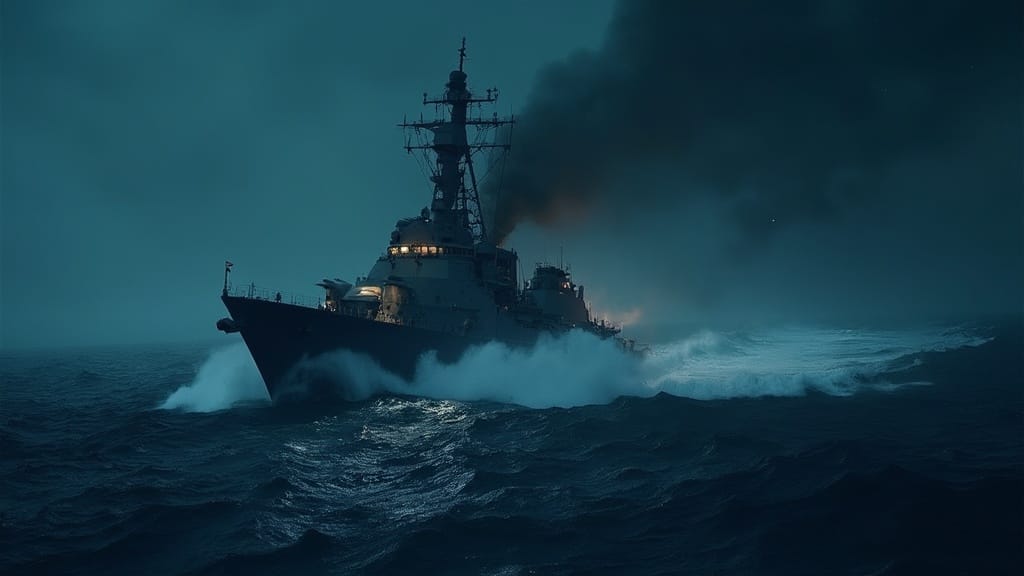
The Big Picture
Iran is holding the global economy hostage through the Strait of Hormuz — and Russia is backstopping Tehran's negotiating position while oil pushes toward $100 a barrel. Meanwhile, China is practicing invasion rehearsals in the Pacific, blocking American tech acquisitions, and quietly shipping open-source AI that undercuts U.S. commercial dominance. This isn't a bad news cycle. This is what strategic encirclement looks like in real time.
Today's Stories
IRAN KEEPS THE STRAIT CLOSED WHILE RUSSIA HOLDS ITS HAND
Tehran submitted a proposal through Pakistani mediators to reopen the Strait of Hormuz — while deliberately kicking the nuclear question down the road. Secretary Rubio called it "better than what we thought they were going to submit," but made clear any deal must block Iran from a weapon. President Trump has not signaled acceptance. Meanwhile, Iran's Foreign Minister Araghchi flew to Moscow Monday, where Putin disclosed he personally received a message from Iran's supreme leader. The message to Washington is plain: Russia is hardening Tehran's floor. The Strait carries roughly a fifth of global seaborne crude. WTI hit $98.97 intraday Tuesday; Brent crossed $107. The IEA is calling this an unprecedented supply shock now in its ninth week. Goldman Sachs doesn't expect Gulf exports to normalize until late June. Every dollar at the pump, every airline ticket, every heating bill — that's the cost of Iran's leverage and Russia's sponsorship of it.
CHINA IS REHEARSING THE TAIWAN INVASION — AND CALLING IT EXERCISES
The PLA Southern Theatre Command staged naval drills east of Luzon — the northernmost major island of the Philippines — explicitly timed to coincide with Balikatan 2026, the U.S.-Philippines exercise that for the first time includes Japanese forces conducting live-fire anti-ship missile drills in waters facing the Taiwan Strait. China's carrier Liaoning moved south in coordination with a PLA Navy task group in the Western Pacific. Beijing called the drills "a necessary action taken in response to the current regional situation." They also broadcast drone footage of Taipei 101 — Taiwan's military called it "typical cognitive warfare." Ships, aircraft, electronic warfare, information operations, and psychological pressure — all stress-tested simultaneously. Our allies in Tokyo and Manila are watching. So should every American who understands that a Taiwan contingency doesn't stay in the Pacific.
PENTAGON ADMITS IT CAN'T STOP HYPERSONIC MISSILES — HERE'S THE SPRINT TO FIX THAT
Pentagon officials acknowledged this week what war planners have known privately for years: the United States has no reliable way to intercept the hypersonic missiles Russia and China already field. Russia operates the Avangard and Zircon. China fields the DF-17 and YJ-21. Both maneuver in an atmospheric corridor legacy U.S. radars and interceptors were never built to cover. The response is a two-track sprint. California startup Castelion won a nearly $105M Navy contract to integrate a Mach 5+ weapon onto F/A-18 Super Hornets by 2027. Northrop Grumman's Glide Phase Interceptor received a $475.3M contract increase, pushing the program past $1.3B toward a June 2028 milestone. Above both sits Golden Dome — the $17.9B FY2027 missile defense initiative with $24.4B already obligated. This is what defense investment looks like when the threat is real. The question is whether we move fast enough.
CHINA JUST KILLED META'S AI ACQUISITION — AND NOBODY IN WASHINGTON IS CALLING IT WHAT IT IS
China's National Development and Reform Commission ordered Meta and Manus — a Singapore-registered AI agent startup with Chinese founders — to withdraw from their $2 billion acquisition deal. Beijing blocked an American company from buying an AI firm. Full stop. This is economic warfare dressed in regulatory language. The NDRC's intervention means cross-border AI mergers and acquisitions are now a national-security choke point Beijing controls. Every Silicon Valley firm targeting the next hot agent startup with mainland Chinese connections — which is most of them — now has to price in Beijing's veto. Meanwhile, Xiaomi shipped a 1-trillion-parameter open-source AI coding model under a permissive MIT license that benchmarks show is 40-60% more token-efficient than American competitors including OpenAI and Anthropic. China is blocking our acquisitions while flooding the market with its own tools. That's not competition. That's a campaign.
YOUR GOVERNMENT'S DIGITAL INFRASTRUCTURE IS BEING ACTIVELY EXPLOITED — TODAY
CISA confirmed active exploitation of two vulnerabilities affecting Samsung MagicINFO 9 Server — the platform running digital signage in hospitals, airports, and corporate facilities — and D-Link DIR-823X routers. Federal civilian agencies have until May 8 to patch. The Mirai botnet has documented history targeting the Samsung platform. Separately, more than 1,300 internet-exposed federal SharePoint servers remained unpatched as of last week against a critical vulnerability with a CISA deadline of April 28 — today. APT28, the GRU's Unit 26165 hacking team, is actively exploiting a separate Microsoft Office vulnerability against Ukraine and EU targets, per CERT-UA. Russia's GRU is running active offensive cyber operations against our allies while over a thousand of our own government servers sit exposed. This is not theoretical. The targeting map is open.
What to Watch
- [CONFIRMED] If Wednesday's EIA petroleum report shows a surprise crude inventory draw, then WTI breaks $100 for the first time since early April, inflation breakevens widen, and the Fed's path to any 2026 rate cut effectively closes. (Confirmed: based on Goldman Sachs forecast and current WTI near $99)
- [ASSESSED] If Trump publicly rejects the Pakistani-mediated Hormuz proposal, then markets will price a longer closure — pushing Goldman's late-June normalization assumption further out and extending energy cost pressure on American households and businesses through summer. (Assessed: analytical projection based on reported negotiating dynamics)
- [ASSESSED] If Japan's Type 88 live-fire anti-ship exercise proceeds without a PLA close encounter, then allied military operations in the first island chain establish a new operational baseline — one Beijing will feel compelled to challenge in the next exercise cycle. (Assessed: based on reported PLA response patterns and current drill composition)
- [SPECULATIVE] If France, Poland, or Italy introduce administrative measures paralleling Germany's new military travel permit requirement for men under 45, then Europe's rearmament has crossed from procurement into full mobilization infrastructure — a threshold not seen since the Cold War. (Speculative: early signal based on Germany's December 2025 legislation; no confirmed parallel moves yet)
The Closer
Three adversaries — Iran, Russia, and China — are coordinating pressure across energy, military, technology, and cyber domains simultaneously, and they are not doing it by accident. America has the tools, the talent, and the industrial capacity to answer every one of these threats. What's required is the clarity to name them, the will to fund the response, and the speed to move before the window closes. The briefing is on the table. The question is whether Washington is reading it.